Tuesday, March 1, 2011

Newest Fox News piece: So How Much Do Public Union Workers Really Make?

My newest Fox News piece starts this way:

President Obama lashed out at Republicans Monday for having "denigrated or vilified" public union employees. Without collective bargaining and the ability to go on strike, he said we wouldn't be able to attract "the best and the brightest to public service." Are public employees simply the best and the brightest? Or are we simply lavishing them with much better employment deals than their private counterparts?
To measure how attractive a job is, economists study how employees vote with their feet -- that is, comparing the rate at which different categories of employees voluntarily quit their jobs.
Over the last six months, private workers have been 3.4 times more likely to quit their jobs than either state and local or federal workers. Indeed, no private industry comes close to the low "quit rate" for government employees. Manufacturing, which has the lowest rate, still faces twice the quit rate as the government. . . .


Labels: , , ,

Friday, March 7, 2008

So where do you think that the best teachers are going to go?

To the New York Times, this is an open question. The title on their article asks: "Would six-figure salaries attract better teachers?" Obviously, higher salaries mean that more teachers will apply for the jobs. The schools might not select the best teachers (public schools might hire people based upon tenure or political views or whatever. Charter schools have more of an incentive to pick the best teachers, though not as much as a private for profit operation would. From the Times:

The school, which will run from fifth to eighth grades, is promising to pay teachers $125,000, plus a potential bonus based on schoolwide performance. That is nearly twice as much as the average New York City public school teacher earns, roughly two and a half times the national average teacher salary and higher than the base salary of all but the most senior teachers in the most generous districts nationwide.

The school’s creator and first principal, Zeke M. Vanderhoek, contends that high salaries will lure the best teachers. He says he wants to put into practice the conclusion reached by a growing body of research: that teacher quality — not star principals, laptop computers or abundant electives — is the crucial ingredient for success.

“I would much rather put a phenomenal, great teacher in a field with 30 kids and nothing else than take the mediocre teacher and give them half the number of students and give them all the technology in the world,” said Mr. Vanderhoek, 31, a Yale graduate and former middle school teacher who built a test preparation company that pays its tutors far more than the competition. . . .


Some express doubt:

Yet the model is raising questions. Will two social workers be enough? Will even the most skillful teachers be able to handle classes of 30, several students more than the city average? . . .


As someone who has taught for many years, I think that a good teacher can accomplish a lot with a bunch of bureaucrats being around. If the teacher doesn't work, the key is being willing to replace them with someone else.

Labels: ,

Monday, August 13, 2007

The liberal imbalance in Academia

Seventy-six percent of the education industry's total federal contributions for '08 has gone to Democrats, on par with the industry's partisanship in the last two election cycles. Perhaps more surprising than the industry’s party split is its sheer size: Education was the eighth-largest industry in terms of all federal campaign contributions in 2004 and the 13th largest in 2006, meaning that in the last two election cycles, college employees contributed more to politicians than the oil and gas industry, which ranked 16th in both cycles. For 2008, CRP ranks the education industry as No. 14, still ahead of big-givers such as oil and gas, general contractors, the computer and Internet industry, electric utilities and the pharmaceutical industry.


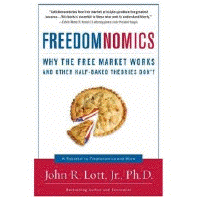
My new book, Freedomnomics, tries to explain why academia is as heavily liberal as it is and, more importantly, how the tenure process works to keep it that way.

Thanks to Butch Browning for sending me the link to this study.

Labels: , ,

Saturday, March 3, 2007

Teacher's union is trying stop Utah Voucher Law

Surprise, the Utah teacher's union is trying stop the recently enacted voucher system in the state. It is understandable that the teacher's union dislikes competition. One positive note is that the teacher's union has tried petitions before on gun issues and they have failed (Utah's petition rules require that petitioners get signatures from across the state and not just liberal Salt Lake City and that lowers the chances of getting something on the ballot). Given that the union is probably more motivated this time, the odds are higher, but they still might fail. My guess is that once vouchers are in place for a while, it will be a lot like concealed handgun laws. People will wonder what all the concern was about.

Less than 24 hours after the Legislature adjourned, opponents of the school voucher program applied for a referendum petition that could land a final decision in the hands of voters in the next general election.
Utahns for Public Schools, a group formed to head up the task of gathering nearly 100,000 signatures — 91,998 to be exact — in the next 40 days, filed the application asking Lt. Gov. Gary Herbert to consider their cause.
"This is so important that the people in this state should get to vote on it," said Pat Rusk, former president of the Utah Education Association. "We are going to make sure that the citizens of Utah get to decide if they want their tax dollars going to private schools." . . . .

Labels: , ,

Sunday, February 4, 2007

Utah House Passes Universal Voucher Bill

It is too bad that this passed only after Milton Friedman had died, but it is still quite a testiment to the influence that he had on the nation's public debate. This will have a bigger impact on schooling in big cities. The shame is that competition is still not occurring in the biggest cities in the US with horrible public school systems.

School voucher opponents, dejected after the House voted 38-37 Friday in favor of a school voucher bill, predicted supporters will one day regret their votes.
They fully expect HB148 to sail through the Senate and win Gov. Jon Huntsman Jr.'s signature, but rather than calling for a constitutional challenge or a repeal effort, they spoke only of "bad policy" and escalating costs.
"I'm terribly disappointed. I think people sold out from fear of special interest groups," said Rep. Carol Spackman Moss, D-Holladay, a retired teacher.
If the bill is signed and becomes law, the heavy lifting would fall to the Utah Office of Education, which would have to get the program up and running by summer so parents can use their vouchers by fall.
"It's a huge assignment and [the bill is] very prescriptive," said Carol Lear, attorney for the Utah Office of Education.
Voucher supporters embraced each other in the halls after the vote.
"We've been chewing on this issue for seven years," said Rep. Stephen Urquhart, R-St. George, who sponsored this year's bill. "We learned from the dialogue, and we have passed something that will be beneficial to some families and it will be beneficial to the system overall."
HB148 would let parents spend public money on private school tuition. Families whose children already attend private schools would be exempt unless they are low-income, but every family with children in public schools would be eligible for vouchers ranging from $500 to $3,000. Public schools would lose some but not all state money for every voucher student who leaves. . . . .

Labels: , ,