Friday, February 11, 2011

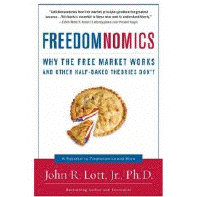
New Chinese edition of Freedomnomics


This is still my favorite book. If anyone knows how to find the order link for the Chinese version, I would appreciate finding out. The English version can still be found here.

Labels:

Sunday, September 27, 2009

Hardcover Freedomnomics at new low paperback price

Freedomnomics is now 63 percent off and selling for only $10.26, cheap even for most paperbacks.

Labels:

Saturday, October 6, 2007

More benefits from Ann Coulter mentioning my book

Saturday, August 18, 2007

CSPAN 2 Showing Talk on Freedomnomics

CSPAN 2 Booknotes TV will show a presentation on my book on Saturday, August 18th at 7 PM EDT.

Labels: , ,

Extensive interview with Bill Steigerwald at the Pittsburgh Tribune-Review

Another Review of Freedomnomics

An Australian weighs in on Freedomnomics with a lengthy, thoughtful review. I particularly appreciated his conclusion:

IF YOU ARE LOOKING FOR ONE BOOK TO EXPLAIN FREE MARKET ECONOMICS TO YOU, THIS IS IT!

Labels: ,

Thursday, August 16, 2007

Regulating Prescription Drug Prices Will Cost Lives

Tuesday, August 14, 2007

Reputations matter, even for China

Monday, August 13, 2007

Video from C-SPAN performance can be seen here

This weekend C-SPAN's BookTV aired a great presentation at the Heritage Foundation on my new book Freedomnomics. You can view the film here.

Labels: , , ,

Saturday, August 11, 2007

Freedomnomics on C-SPAN this Weekend

This Sunday, August 12, at 11:00 AM EDT; Sunday, August 12, at midnight EDT; and Saturday, August 18, at 7:00 PM EDT C-SPAN 2's Booknotes will have a presentation on my new book. The discussion each time will last an hour.

My appearance on CSPAN 2's Booknotes seems to have engendered some reaction:

On the positive side you can find this: "I almost forgot to mention that John will discuss his terrific book, Freedomnomics, on C-SPAN at 11:00 am EDT. The interview repeats at midnight and the booktv site has the full schedule for subsequent replays.

Go see it, the book is wonderfully ingenious, clearly written, and the balance of evidence and analysis makes John one of the formidable economists in the public policy arena."


On the negative side you can find this: "John Lott is scary. He's on CSPAN2 right now, giving talk on his book. What's scary about the guy is that he has no concept of the idea that human beings might be less than rational in the way they go about making life decisions. He really thinks everybody is hyper-rational. And, he's the chief economist for the US Sentencing Committee." I did put in a reply to his post on his website. I should also mention that I am no longer chief economist at the United States Sentencing Commission.

Labels: , ,

Friday, August 10, 2007

The Abortion Debate Gets Heated

I guess that it would have been helpful if Ms. Marjorie Signer had actually explained why my research showing that the liberalization of abortion rules increased crime contained "many unfounded, fallacious, racist, and confused assumptions."

"Lott offers so many unfounded, fallacious, racist, and confused assumptions that his overall opinions are useless," said Marjorie Signer, spokeswoman for the Religious Coalition for Reproductive Rights, in a statement sent to Cybercast News Service.

"To speculate that abortion is responsible for various and sundry social trends is irresponsible and misses critical points," she said.

"Abortion has always been an option that women at all socioeconomic levels have considered, and many abortions are performed for medical reasons. Trying to correlate abortion with social trends smacks of pseudo-science and shows little understanding of women's lives and decisions," Signer added. . . . .


John Donohue also refused to comment on the actual research, but was reduced to saying this: "I am a social scientist, however, so Lott's behavior has in my mind, put him outside the bounds of scientific discourse." That will certainly settle the debate, though I can understand why Donohue is reluctant to actually discuss the facts on this issue. Since John Whitley co-authored this paper with me, does Donohue's statement tar Whitley also?

Donohue also doesn't comment on recent issues regarding his co-author Levitt.

Labels: , , , ,

Thursday, August 9, 2007

Another Review of Freedomnomics

Wednesday, August 8, 2007

Another Review of Freedomnomics

This cliché of government intervention might not be the effective long-term solution for the economy that many trust it to be. John R. Lott, Jr., PhD, author of the newly-published book Freedomnomics: Why the Free Market Works and Other Half-Baked Theories Don’t, believes that government intervention into a free market can adversely affect the economy. Lott further maintains that many so-called “market failures” actually become profit opportunities for those people who work to solve the problems.

Dr. Lott was at the Heritage Foundation last Wednesday to discuss his book and explain his thesis supporting a free economy despite its shortcomings. Lott drew upon multiple examples from his book to prove that the free market works most effectively with as little government intervention as possible, and is actually able to solve its own market failures over time, contrary to popular opinion. Also, Lott expounded upon the long-term domino effects that touch society when the government exercises sufficient power. . . . .

Labels: ,

Monday, August 6, 2007

The penalties faced by white collar criminals

This article only mentions the prison term faced by Fingerhut. But of course he will have to provide full restitution and fines. He is retired so he doesn't have to look for a job again because if he did (as I have pointed out in Freedomnomics), he would have an almost impossible task. There is also a high probability that his wife will divorce him and take most of his assets.

In his day, Bert Fingerhut was a Wall Street player. A top-ranked securities analyst for eight straight years, making calls that moved markets, Mr. Fingerhut rose to director of research at Oppenheimer & Co. in 1980. Three years later, he retired to Aspen, Colo. He was 40 years old.

In the Rockies, Mr. Fingerhut became as passionate about conservation as he once was about stocks. He joined the boards of a string of environmental organizations. So devoted was he to the wilderness that he got married in Wyoming's Grand Teton National Park.

But he couldn't get Wall Street out of his system. In the 1990s he picked up a copy of Peter Lynch's "Beating the Street," in which the former star manager of the Fidelity Magellan Fund wrote of a "can't-lose proposition (almost)" called bank-conversion investing.

When mutual, depositor-owned banks convert to public companies, Mr. Lynch noted, they must let depositors buy stock at the initial-public-offering price. The new shares are often priced at a discount. So "the next time you pass a mutual savings bank or an S&L that's still cooperatively owned," Mr. Lynch suggested, "think about stopping in and establishing an account."

Mr. Fingerhut took the advice to heart, and then some. Starting in 1995, he opened accounts at more than 400 banks across the country, from Wellsburg, W.Va., to Covina, Calif. He eventually got in on public offerings at many of them, and flipped their shares for quick profits. Over a decade, he made $11 million from the strategy.

There was one problem: The way he did it, he was breaking the law.

In May, Mr. Fingerhut pleaded guilty to conspiring to defraud banks and their depositors by secretly using other people as fronts to open accounts for him, thus increasing the number of IPO shares he could buy. He forfeited all the money he earned from the strategy. On Friday, a federal judge in Newark, N.J., sentenced the onetime star stock analyst to two years in prison.
. . . .


Thanks to Jack Langer for sending this article to me.

Labels: , ,

Wednesday, August 1, 2007

Another Review of Freedomnomics

Phil Miller over at Market Power has a review of Freedomnomics:

John Lott has given us a book that gives an important perspective on the workings and intricacies of markets and what happens when private citizens are economically free.


John Palmer has more thoughts here and Stephen Karlson has his comments here.

Labels: ,

Heritage Talk Available Here

The talk that I gave at the Heritage Foundation can be found here. Hopefully it provides a quick understanding of economics is and how powerful of a tool it is. For those with Windows and Windows Media Player you can watch the presentation here.

Labels:

Tuesday, July 31, 2007

New Piece in National Review

Abortion and Crime — by John R. Lott Jr.
One has an effect on the other, but it may not be the effect you think.

Violent crime in the United States shot up like a rocket after 1960. From 1960 to 1991, reported violent crime increased by an incredible 372 percent. This disturbing trend was seen across the country, with robbery peaking in 1991 and rape and aggravated assault following in 1992. But then something unexpected happened: Between 1991 and 2000, rates of violent crime and property crime fell sharply, dropping by 33 percent and 30 percent, respectively. Murder rates were stable up to 1991, but then plunged by a steep 44 percent.

Several plausible explanations have been advanced for the drop during the 1990s. Some stress law-enforcement measures, such as higher arrest and conviction rates, longer prison sentences, “broken windows” police strategies, and the death penalty. Others emphasize right-to-carry laws for concealed handguns, a strong economy, or the waning of the crack-cocaine epidemic.

Of all the explanations, perhaps the most controversial is the one that attributes lower crime rates in the ’90s to Roe v. Wade, the Supreme Court’s 1973 decision to mandate legalized abortion. . . . .
.


This piece requires a subscription, though it is largely based on the discussion that I have on this issue in my book, Freedomnomics.

By the way, in the same issue Ramesh Ponnuru has a useful discussion on the gun control debate, though I believe that he is a little too optimistic.

Labels: , , ,

Monday, July 30, 2007

One of the many penalties some criminals face: Lost inheritance

PARTY princess Paris Hilton is $60 million out of pocket after her billionaire grandfather - appalled by her jail term for drink-driving offences - axed her inheritance.

Family patriarch Barron Hilton was already embarrassed by his granddaughter's wild behaviour - notably when her home sex video was leaked on the internet.

But the 79-year-old considered her 23-day sentence last month the last straw. . . . .


People who are disinherited because of criminal activity face an essentially almost impossible road in challenging that decision in court. If you thought that Paris' prison term was already harsh for the type of crime that she had committed, add $60 million to that penalty.

Thanks to Alex Robson for sending this story to me.

Labels: ,

New Piece in National Review

Abortion and Crime — by John R. Lott Jr.
One has an effect on the other, but it may not be the effect you think.

Violent crime in the United States shot up like a rocket after 1960. From 1960 to 1991, reported violent crime increased by an incredible 372 percent. This disturbing trend was seen across the country, with robbery peaking in 1991 and rape and aggravated assault following in 1992. But then something unexpected happened: Between 1991 and 2000, rates of violent crime and property crime fell sharply, dropping by 33 percent and 30 percent, respectively. Murder rates were stable up to 1991, but then plunged by a steep 44 percent.

Several plausible explanations have been advanced for the drop during the 1990s. Some stress law-enforcement measures, such as higher arrest and conviction rates, longer prison sentences, “broken windows” police strategies, and the death penalty. Others emphasize right-to-carry laws for concealed handguns, a strong economy, or the waning of the crack-cocaine epidemic.

Of all the explanations, perhaps the most controversial is the one that attributes lower crime rates in the ’90s to Roe v. Wade, the Supreme Court’s 1973 decision to mandate legalized abortion. . . . .
.


This piece requires a subscription, though it is largely based on the discussion that I have on this issue in my book, Freedomnomics.

By the way, in the same issue Ramesh Ponnuru has a useful discussion on the gun control debate, though I believe that he is a little too optimistic.

Labels:

Friday, July 27, 2007

John Palmer at the University of Western Ontario Begins Reviewing Freedomnomics